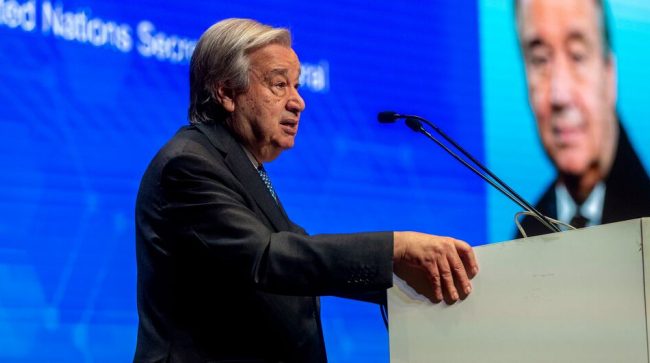





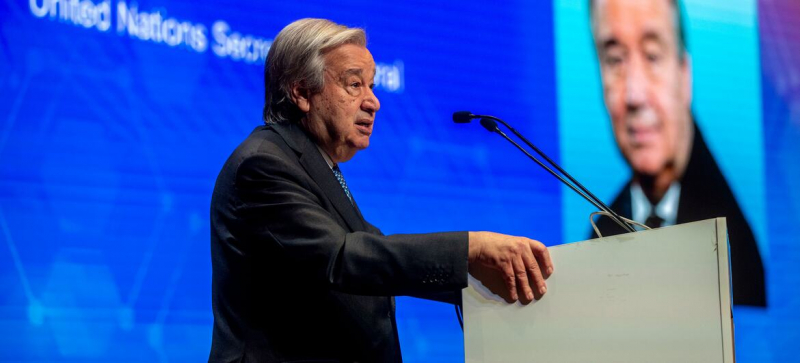

UN Secretary-General Antonio Guterres speaks at the summit in New Delhi. UN chief: scientific approach to AI management will help accelerate sustainable development Sustainable Development Goals
UN Secretary-General Antonio Guterres emphasized the key role of science in the global governance of artificial intelligence, speaking Friday at an event in New Delhi, India, on the sidelines of the AI Impact Summit.
“By drawing on science, we can transform artificial intelligence from a source of uncertainty into a reliable driver of achieving the Sustainable Development Goals,” he said.
The Secretary-General called on the international community to build a future “in which policies are as smart as the technologies they are designed to guide.”
New expert group
Guterres noted that “AI innovation is advancing at the speed of light, outpacing our collective ability to fully understand it, let alone manage it effectively.” According to him, for artificial intelligence to serve the benefit of humanity, policy should not be based on guesswork. What is needed is “facts that can be trusted and shared across countries and across sectors.”
This is why the UN is developing mechanisms that put science at the center of international cooperation in the field of AI. In particular, an Independent International Scientific Group on Artificial Intelligence was recently created, which included 40 leading experts.
The group aims to reduce the “AI knowledge gap” and assess the real impact of new technologies on the economy and society, so that states can make decisions with the same clear understanding of the situation, regardless of the level of development of their own technologies.
Accelerating progress and preventing risks
“The group will provide a common analytical framework, helping Member States move beyond philosophical discussions to technical coordination and rely on evidence when making decisions,” the UN head emphasized.
Read also:
He said that scientifically based control of AI will not slow down progress, but, on the contrary, will speed up decision-making. This approach will allow countries to more quickly identify where technologies can bring the greatest benefit, and ensure that development is safer, more equitable and accessible to all.
In addition, the international community will be able to proactively identify potential impacts of AI, such as risks to children or the labor market, allowing countries to “prepare, protect people and invest in their future.”
Risk of fragmentation
Guterres noted that international cooperation today is complicated by declining trust and increasing technological rivalry.
“Without a common framework, fragmentation takes over: different regions begin to operate within incompatible policies and technical standards,” the UN chief warned. This, he says, only increases costs, reduces safety and deepens inequality.
The Secretary-General indicated that countries could agree on “technical guidelines”, building on the work of the International Panel and another UN initiative, the Global Dialogue on AI Governance, which will be held in Geneva in May.
Human control
Concluding his speech, the UN head emphasized that human control over AI should be “a technical reality, not a slogan.”
This means the need for “real human oversight in high-stakes decision-making—in justice, healthcare, lending,” as well as clear accountability systems so that responsibility “is never shifted to an algorithm.”
“People must understand how decisions are made, be able to challenge them and get answers,” concluded the Secretary General.