


The topic A little bit Black & White, a little bit Fable, Molyneux’s citybuilder… is currently the subject of lively discussion — readers and analysts are keeping a close eye on developments.
This is taking place in a dynamic environment: companies’ decisions and competitors’ reactions can quickly change the picture.
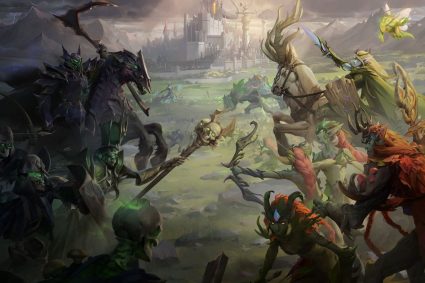
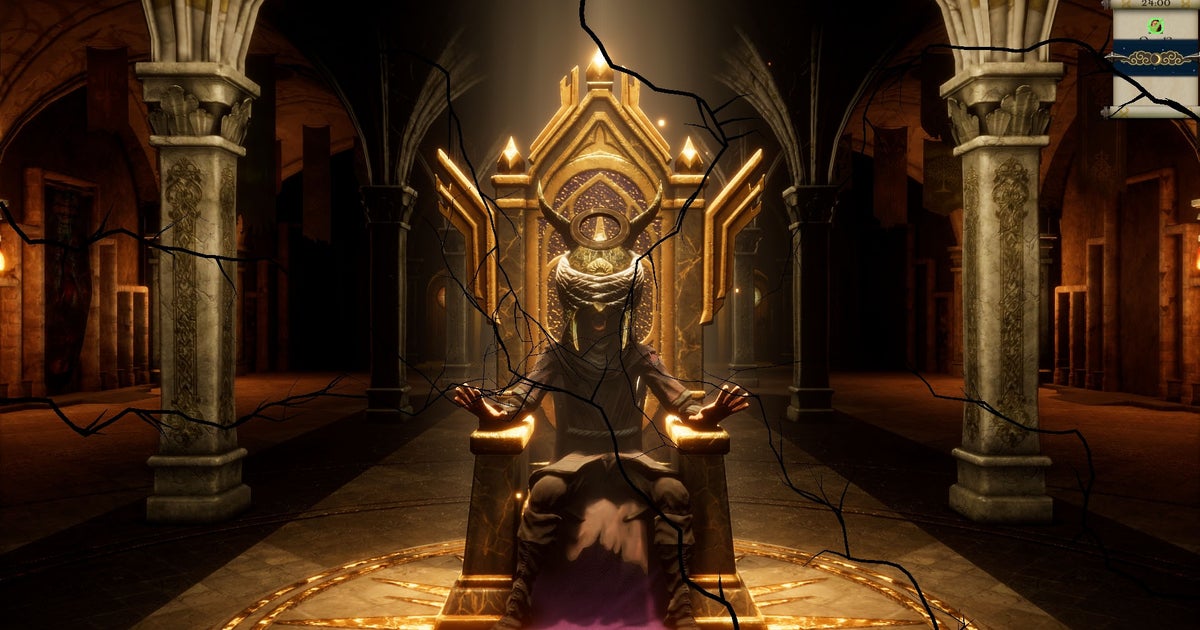
Every time the ghoul smacks his hands against my crypt, a red light pulses and sends cracks spiderwebbing across my screen. If I don’t beat down the undead creature soon, he’ll break into the tomb and kill my character in his sleep, forcing me to restart the day. It should be easy to kill the monster, after all, I’ve two strapping heroes nearby, multiple ballista towers, and my godhand courses with lightning. But, for some reason my heroes have decided to attack other, less threatening monsters, my towers aren’t shooting the ghoul, and my lightning bolts refuse to strike.
Masters Of Albion, the new god game from Peter Molyneux’s studio 22 Cans, fizzes with promise, but it has a lot of kinks to work out in early access if it’s going to become more than a bucket of enjoyable mechanics. I don’t mean for that to sound dismissive. There is a lot of fun to be had in this fusion of city builder, crafting, tower defense, god game, but it’s also far from finished.
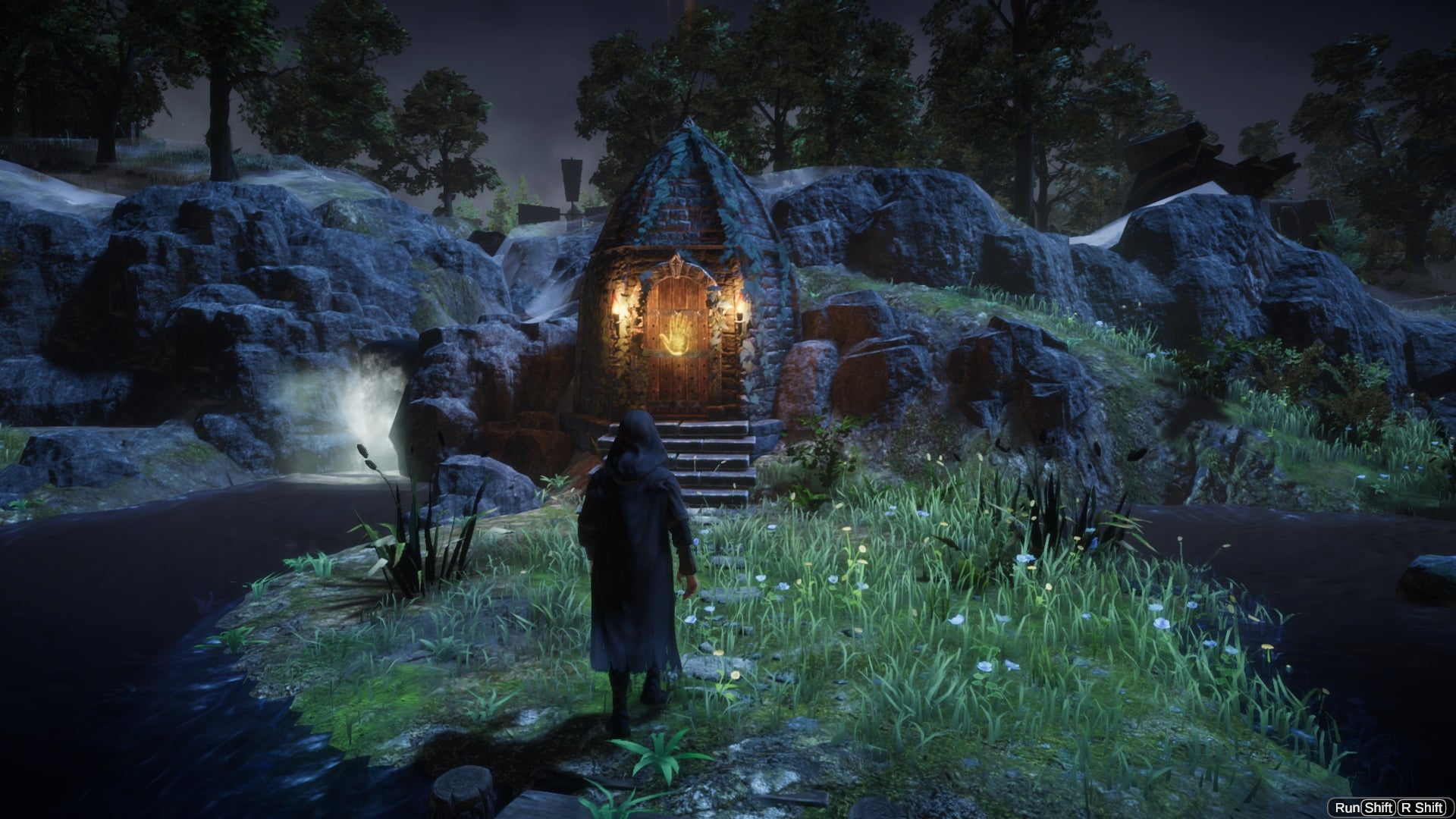
Masters Of Albion is a hodgepodge of influences, a greatest hits of the ideas in many Lionhead Studios and Bullfrog Productions games. Its opening, in which your cloaked figure walks through a misty forest in third-person and stumbles upon a ruined and overgrown village feels straight out of Fable – especially as you’re immediately given the option to kick a chicken, sending it soaring through the air, trailing clucks behind it. In the village you discover a glowing crypt and, inside it, an ancient throne. You sit, put on a magical crown, and give up your body to become a god.
The transition sends you skyward, giving you a bird’s eye view of the overgrown hamlet. An advisor, Valmey, tells you in a thick West Country accent to defend what’s left of the village from a ghoul raid. The monsters start rising out of the ground near a graveyard on the edge of town. Using your great, deistic hand, you can lift and fling boulders, knocking the ghouls down like skittles. At first I thought my aim was exceptional, as though 25-year-old Black & White muscle memory was kicking in, but it’s actually a generous auto-aim doing the work. (I’m thankful for this, nothing makes me feel quite so ungodlike as clumsiness).
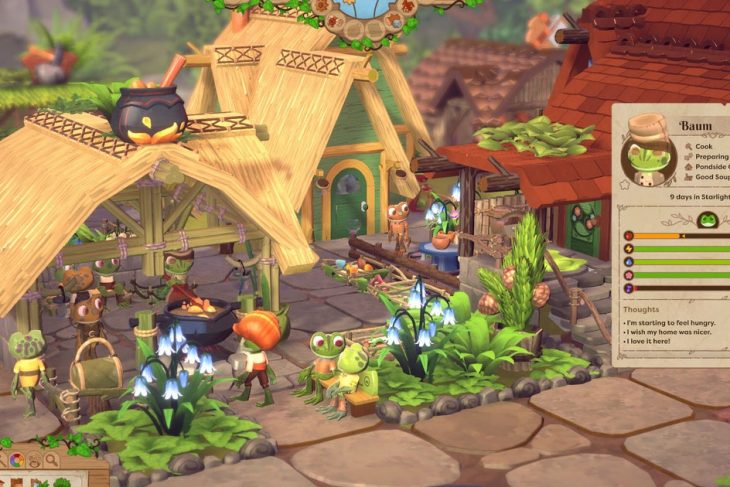
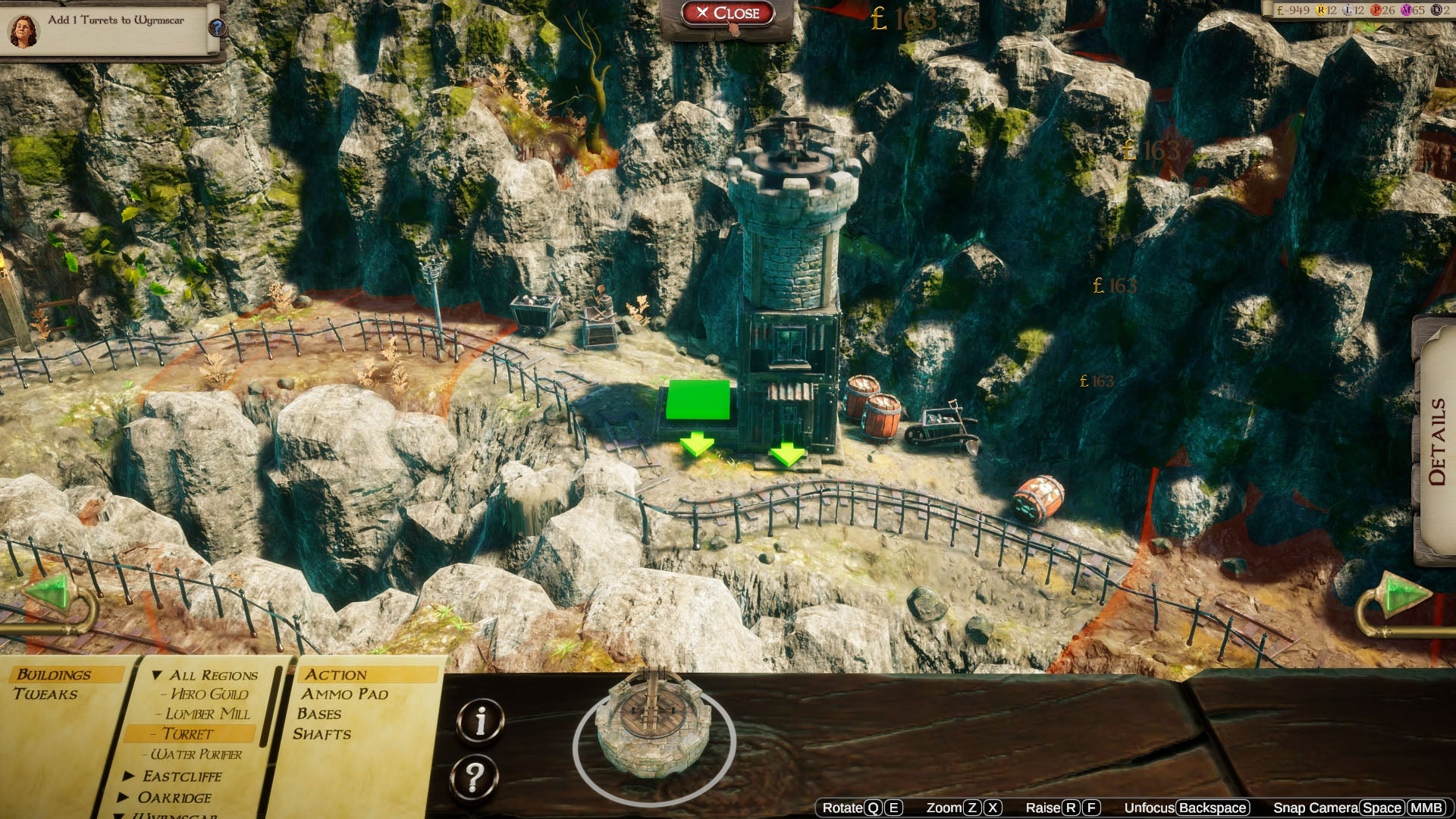
Once the wave is defeated, Valmey sets you to restoring the village. Clicking and holding on the piles of vine-covered rubble shakes off the overgrowth, revealing chunks of buildings beneath. These chunks – bits of roof, whole bedrooms, factory workshops, etc – are all functioning components you can cobble into new structures. Snap together an entrance way, a double bedroom, and a water purifier and you’ve a home that will also replant and water the fields in town. Slap a ballista on top and an ammo platform round the back and it will shoot zombies, too. It’s wonderfully tactile and toylike, not as granular as Lego, but more flexible than the action figures that combine into a Power Rangers-like Megazord when stuck together in exactly the right sequence.
However, there are surprising limits to your constructions. You can’t double up the defensive power of a ballista tower by adding a second pillar, for instance, as you’re only able to place one base from which to build a tower. Oddly, nothing stops you from building a tavern with two ballistae on its roof, except only one of them seemed to work when the enemy came near. Masters Of Albion is in Steam Early Access and it’s this sort of clunkiness and inconsistency I really hope gets ironed out with updates, because it makes what should be a playful system much less intuitive.
The reason you’re cobbling together production buildings is because a significant part of your time in Masters Of Albion is playing a citybuilder about fulfilling different goods orders. Though, contrary to the likes of Anno 117, where to make complex dishes you need to establish diverse food sources, such as pig pens, vegetable patches, wheat fields, and dairy farms, bringing them all together at a production facility, here you only need one food source to make every dish: wheat. Your farmers work a field, carry the wheat to a mill where it is ground into flour, which is then taken to a factory and baked into a foodstuff.
There is still complexity, as you need to design a bespoke dish for every food order. Tricky McDicky, a local lord, might ask you for 61 ‘balanced’ pies, but what you actually provide him is up to you. You could fill a pie dish with rat, chicken, strawberries, lettuce – whatever ingredients you’ve unlocked for the pantry. While you have free rein, every order comes with a cryptic hint as to what will make the customer happy. McDicky’s request, for instance, comes with the line ‘None die for a pie’. One veg stock with stilton pie coming up.
Every order also comes with a desired quality rating and each ingredient contributes to the dish’s quality, but each new ingredient also means it will take more wheat to produce, so you want to aim to hit the quality level with the lowest number of components possible, while also not breaking the cryptic rule provided. As minigames go, it’s not too complicated, but there is a charm to seeing the product you designed roll off the factory floor and carried to a waiting airship by your townspeople.
There are more complexities to the system – satisfying a customer’s demands can boost your reputation to earn you buffs on their future orders, and there is a shifting market where some ingredients are more valuable on some days compared to others – but these feel largely out of my control. If a customer wants a veggie pie, I’ll use the veggie goods, whether they’re high value or not. And, as you’re only offered one order at a time, it’s not like you can pick one order over another to make a more valuable product.
Your godliness isn’t forgotten in all of this pie baking and armour making. If you click and hold a production building, you can force your people to work faster. You can also get stuck in and drag goods from one building to another, speeding things up. As with construction, this interaction creates a lovely physicality to your presence in the world. There currently doesn’t seem to be any consequence to your chivvying people along; there’s not a morale or happiness stat in the game, so when I found myself in debt – which is easy to do when you’re fitting costly new rooms to buildings – I’d spend long periods of time just racing my people through goods orders until I was back in the black. It’s good to have a way of speeding your way out of debt, but it’s not particularly engaging to just click and hold buildings in turn.
Once you’ve completed the day’s objectives, you can progress to surviving a ghoul-filled night. This is where you switch from a citybuilder to tower defense. The undead will begin to rise from graveyards across the map and descend on your town. You can fight the horde back with ballistae, hero units, and godly powers fired from your hand, but this side of the game is significantly more awkward than the citybuilding.
Heroes are special units you can recruit in small numbers once you’ve built a Heroes Guild to house them. Lovingly called ‘Beefcakes’ by advisor Valmey, you can arm and clothe these toughs with weapons and armour your design in your factories. Pick them up with your godhand and place them near an enemy and they’ll march straight into battle, thwacking left and right until the ghouls are knocked out or they are. You can also possess your heroes, dropping into third-person control and doing battle with the undead yourself. It’s clunkier than the combat in Fable, but forgivably so considering how many other genres are on offer in this one game. You can use this possession ability whenever you want, and some quests demand it, such as when you must escort a lost merchant into town. Which means you have to enjoy his cries of “Where are you going, fat neck? Come back!” in person.
Despite their power, the beefcakes are hamstrung by their chicken brains, only attacking the nearest enemy and not prioritising threats. As I said up top, when a ghoul was attacking my crypt, a game-ending threat, both my heroes were ignoring them to focus instead on the enemies right next to them. I could have just possessed one of them, but you can only use your powerful god powers when you’re in the bird’s eye view.
The first power you unlock is the ability to shoot lightning from your fingertips. However, where that bolt hits isn’t fully in your control, sometimes striking your intended target, sometimes someone near them, other times not firing at all. This is particularly frustrating when there is an enemy threatening your crypt and despite looming over them with all the power of Zeus at your beck and call, you can’t seem to smite them. As I say, nothing punctures feeling godlike than clumsiness.
Finally, despite littering my land with ballista towers, these structures seem to only intermittently fire on their targets. Whether their view is blocked or they’re bugged, I can’t tell and it means that I can rarely leave them unattended and trust they’ll be able to deal with an enemy wave.
The ghouls themselves are straightforward enemies, with melee zombies and skeleton archers making up the bulk of their waves. But one enemy that currently seems overpowered is a suicide zombie who arrives in the world strapped to dynamite. If they get close to your heroes or towers (which they do with exceptional ease) they take them out with a single hit.
Compounding the issue is a clunky interface and control scheme. To use your godpowers you must press ‘H’, but doing so means you can’t pick up your heroes, so you must remember to holster your power if you want to drag a hero out of danger or into battle, a fiddlyness that can mean the difference between success and failure. You can in theory move your towers to more useful positions, but that’s not as simple as clicking and dragging them: you need to right-click the building, select the move order, left drag it to a new position, click a button to accept the new position, and only then does it show you what the tower’s new firing circle is and if you’ve placed it somewhere that can hit enemies. Another annoyance is that when your towers are destroyed, they’re blown into the different components and to repair them you need to drag all the pieces back together in their original order, which, when tower stacks look identical and may have been blown in different directions, is very difficult to do in the heat of battle.
Again, Masters Of Albion is an early access game, and many of these frustrations are exactly the sort of kinks and bugs you would expect to be smoothed out with updates. They’re also areas 22 Cans explicitly note on the Steam page they will be improving.
What I can’t tell is whether there is a great game underneath those awkwardnesses that will be revealed. I like citybuilders and tower defense games, and slapping together ingredients to create horrible rat and lettuce pies is something I can definitely get behind, but currently the systems that are present are shallow. There’s little strategy to the tower defense – walls can only be placed in pre-ordained spots and all the towers are different varieties of projectile weapons. Nor is there currently much challenge in the citybuilding. Because everything you produce needs only one raw resource, wheat or metal, the crafting system isn’t challenging or rewarding; you can make a dish as complex as you want, it will only ever need wheat to create – the only difference is the time it will take your villagers to fulfill the order. And, in Albion, time is an infinite resource, the night only comes when you’ve completed the day’s objectives and invited the enemy waves to begin.
There is promise here, but whether you trust 22 Cans to deliver should be the difference between buying Masters Of Albion now or waiting until its full release.
Sign in and join us on our journey to discover strange and compelling PC games.